Featured

Machine Learning Integrated Development Environment (IDE)

Integrated development environments aka IDEs can be a valuable tool for machine learning development, management, and deployment. They can help developers to write better code, debug code, visualize data, manage projects, and deploy models. But how does regular IDEs differ from the ones used for Machine learning and AI application development? IDEs for machine learning development and normal application development differ in a few key ways:

  • Features: IDEs for machine learning development typically include features that are specifically designed for machine learning, such as:
    • Built-in libraries and tools: IDEs for machine learning development typically have built-in libraries and tools that are specifically designed for machine learning tasks. This can save developers time and effort, as they don’t have to install and configure these libraries and tools themselves.
    • Visualization tools: IDEs for machine learning development typically have visualization tools that can help developers to understand and debug machine learning models. This can be helpful for identifying patterns in the data and for understanding how the model works.
    • Integration with machine learning frameworks: IDEs for machine learning development typically integrate with popular machine learning frameworks, such as TensorFlow, PyTorch, and scikit-learn. This makes it easier for developers to use these frameworks to build and train machine learning models.
    • Integration with machine learning cloud platforms: Normal application IDEs may not have this focus, as they are not as reliant on cloud platforms.
  • Community: IDEs for machine learning development tend to have a larger and more active community of users, which can be helpful for getting help and finding resources.
  • Focus: IDEs for machine learning development tend to be more focused on machine learning, while IDEs for normal application development may be more focused on general-purpose programming.

Here are some of the most popular IDEs available for machine learning and AI development based on the number of downloads, number of active users, number of online tutorials and resources available and community size and activity. These factors may change in future –

Jupyter Notebook

Jupyter Notebook is a web-based interactive development environment (IDE) that is popular for machine learning development. Jupyter Notebooks allow you to combine code, text, and images in a single document, which can make it easier to document your machine learning projects. Jupyter Notebook is used in the Python ecosystem. It is a popular tool for data science and machine learning, and it is often used in conjunction with other Python libraries, such as NumPy, Pandas, and Scikit-learn. P.S. Jupiter notebooks come in different flavors from individual cloud platforms e.g. on Vertex AI (Google’s unified AI platform) it is called vertex AI workbench. It is more powerful, feature rich and expensive than Google Colab.

Pros:

  • Easy to use and learn
  • Combines code, text, and images in a single document
  • Good for documenting machine learning projects
  • Can be run in a web browser

Cons:

  • Not as well-suited for large or complex projects
  • Can be difficult to debug code
  • Not as well-integrated with version control systems as some other IDEs

PyCharm

PyCharm is a popular IDE for Python development, and it also has a number of features that make it well-suited for machine learning. PyCharm provides code completion, linting, debugging, and a number of other features that can help you write and debug your machine learning code. PyCharm is also used in the Python ecosystem. It is a more powerful IDE than Jupyter Notebook, and it offers a wider range of features. PyCharm is often used by professional Python developers, and it is also a good choice for machine learning development.

Pros:

  • Wide range of features for Python development
  • Code completion, linting, debugging, and a number of other features
  • Well-integrated with the Anaconda distribution of Python
  • Community edition is free to use

Cons:

  • Can be a bit heavy and resource-intensive
  • Not as well-suited for other programming languages as some other IDEs

Google Colab

Google Colab is a cloud-based Jupyter Notebook environment that is free to use. Google Colab is a good option if you want to collaborate on machine learning projects with others, or if you want to access your machine learning projects from anywhere. Google Colab is used in the cloud computing ecosystem. It is a web-based IDE that runs on Google’s servers. Google Colab is a good option for machine learning development, as it allows you to access powerful computing resources without having to install any software on your own computer.

Pros:

  • Free to use
  • Cloud-based, so you can access your projects from anywhere
  • Good for collaboration
  • Can run on GPU hardware for faster performance

Cons:

  • Not as well-suited for offline work
  • Can be difficult to set up
  • Not as well-integrated with version control systems as some other IDEs

Spyder

Spyder is a Python IDE that is specifically designed for scientific computing and machine learning. Spyder provides a number of features that are useful for machine learning, such as a graphical debugger, a variable explorer, and a built-in documentation viewer. Spyder is used in the Python ecosystem. It is a scientific Python IDE, and it is often used for data science and machine learning. Spyder offers a number of features that are useful for scientific computing, such as a graphical debugger and a variable explorer.

Pros:

  • Specifically designed for scientific computing and machine learning
  • Provides a number of features that are useful for machine learning, such as a graphical debugger, a variable explorer, and a built-in documentation viewer
  • Well-integrated with the Anaconda distribution of Python

Cons:

  • Not as well-suited for other programming languages as some other IDEs
  • Can be a bit complex to learn

RStudio

RStudio is an IDE for the R programming language, which is another popular language for machine learning development. RStudio provides a number of features that are useful for machine learning, such as code completion, linting, debugging, and a number of other features. RStudio is used in the R ecosystem. R is a popular programming language for statistical computing, and RStudio is a popular IDE for R development. RStudio offers a number of features that are useful for statistical computing, such as a graphical debugger and a console.

Pros:

  • Wide range of features for R development
  • Code completion, linting, debugging, and a number of other features
  • Well-integrated with the R distribution of Python
  • Community edition is free to use

Cons:

  • Not as well-suited for other programming languages as some other IDEs
  • Can be a bit complex to learn

Jupyter Notebook is the most popular IDE for machine learning development. It is easy to use and learn, and it is a good way to get started with machine learning. PyCharm is another popular IDE for machine learning development. It offers more features and functionality than Jupyter Notebook, but it can be a bit more complex to learn. Google Colab is a cloud-based IDE that is free to use. It is a good option if you want to collaborate on machine learning projects with others, or if you want to access your machine learning projects from anywhere. These IDEs are all open source, which means that they are free to use and modify. They are also actively developed by their respective communities, which means that new features and bug fixes are constantly being added.

Ultimately, the best IDE for you will depend on your specific needs and preferences. If you are new to machine learning, I recommend starting with Jupyter Notebook or Google Colab. These IDEs are easy to use and learn, and they are a good way to get started with machine learning. If you are more experienced with machine learning, you may want to try PyCharm or Spyder. These IDEs offer more features and functionality, but they can be a bit more complex to learn. In addition, these IDEs can be used for other AI development. They are not specifically designed for machine learning, but they can be used for other AI tasks, such as natural language processing and computer vision. For example, Jupyter Notebook can be used to develop and deploy AI chatbots, and PyCharm can be used to develop and deploy AI image classifiers.

Featured

Machine Learning Ops- Bridging the Gap Between Machine Learning and Operations

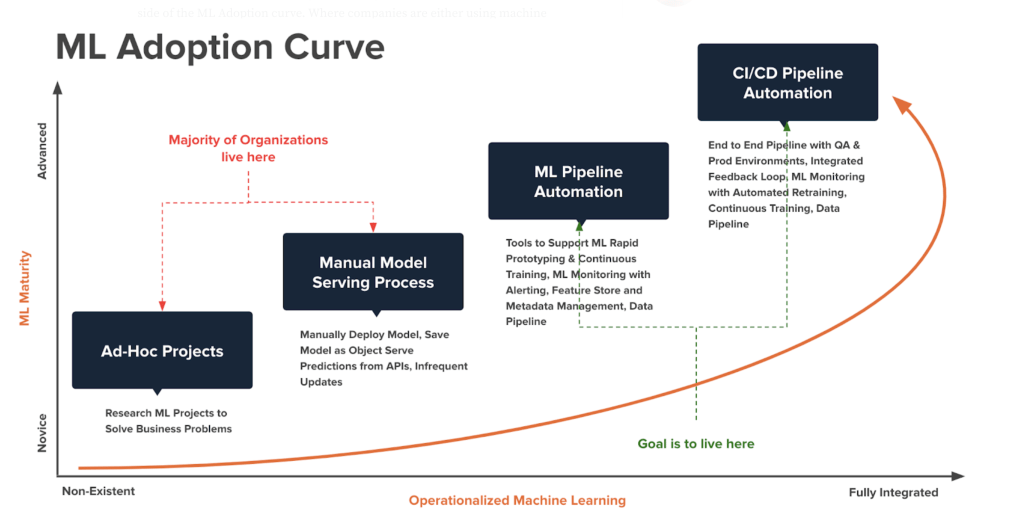
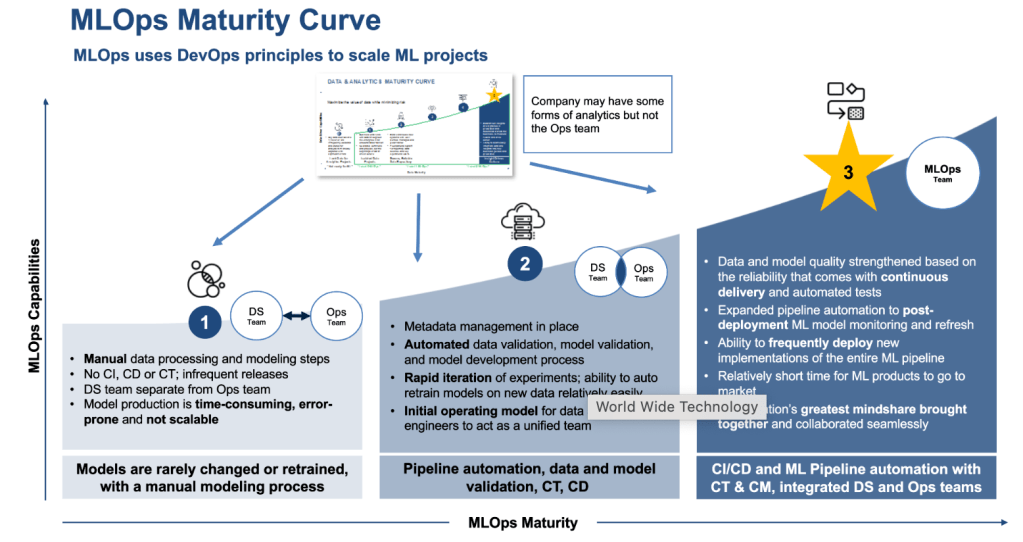
Machine learning (ML) has rapidly become a key component of modern businesses, with organizations using ML algorithms to derive insights, automate processes, and improve decision-making. However, deploying and managing machine learning models in production is often a challenging task that requires close collaboration between data scientists and IT operations teams. This is where MLOps comes in – a set of practices and technologies that aim to streamline the ML lifecycle and bridge the gap between machine learning and operations.

What is MLOps?

MLOps, short for Machine Learning Operations, is a relatively new term that describes the intersection of machine learning and operations. It encompasses the practices, processes, and technologies used to build, deploy, monitor, and manage machine learning models in production. MLOps borrows from the DevOps culture, which emphasizes collaboration and communication between development and operations teams, as well as the use of automation and continuous integration/continuous delivery (CI/CD) pipelines to streamline software development.

Why is MLOps important?

Deploying and managing machine learning models in production is often a complex and time-consuming task that involves multiple stakeholders and steps, such as data preprocessing, model training, validation, deployment, and monitoring. MLOps helps to address some of the key challenges of this process, such as:

  • Versioning and reproducibility: ML models often require specific versions of software libraries and dependencies, and the code used to build them should be versioned and reproducible. MLOps helps to ensure that models are built with the right dependencies and are reproducible, which makes it easier to debug issues and roll back to previous versions if needed.
  • Scalability and performance: Machine learning models can be computationally intensive and require large amounts of data and processing power. MLOps helps to ensure that models can scale and perform well in production by using techniques such as distributed training, load balancing, and resource allocation.
  • Security and compliance: Machine learning models can contain sensitive data or be used in regulated industries, which means that they need to be secured and compliant with relevant regulations. MLOps helps to ensure that models are deployed securely and that they comply with relevant regulations such as GDPR or HIPAA.
  • Monitoring and maintenance: Machine learning models are not static – they need to be constantly monitored and maintained to ensure that they perform well and remain up-to-date. MLOps helps to automate the monitoring and maintenance of models, which frees up data scientists and IT operations teams to focus on more high-value tasks.

MLOps Practices and Technologies

MLOps encompasses a wide range of practices and technologies, depending on the specific needs and context of an organization. However, some of the key practices and technologies used in MLOps include:

  • Continuous Integration/Continuous Delivery (CI/CD): CI/CD is a software development practice that emphasizes automation and continuous feedback to improve the speed and quality of software development. In MLOps, CI/CD is used to automate the deployment of machine learning models, as well as to ensure that models are versioned and reproducible.
  • Infrastructure as Code (IaC): IaC is a practice that involves managing infrastructure resources (such as servers or databases) using code. In MLOps, IaC is used to automate the provisioning and management of infrastructure resources that are used to train and deploy machine learning models.
  • Model Versioning: Model versioning is the practice of tracking changes to machine learning models over time. In MLOps, model versioning is used to ensure that models can be reproduced and that issues can be easily tracked and resolved.
  • Automated Testing: Automated testing is the practice of using software tools to automatically test machine learning models. In MLOps, automated
  • testing is used to ensure that models meet certain quality standards and that they perform as expected in different scenarios.
  • Model Monitoring: Model monitoring is the practice of continuously monitoring the performance of machine learning models in production. In MLOps, model monitoring is used to detect and diagnose issues with models, as well as to identify opportunities for improvement.
  • Containerization: Containerization is the practice of packaging software applications (including machine learning models) in lightweight, portable containers that can be run consistently across different environments. In MLOps, containerization is used to simplify the deployment and management of machine learning models, as well as to improve scalability and performance.

MLOps Workflow

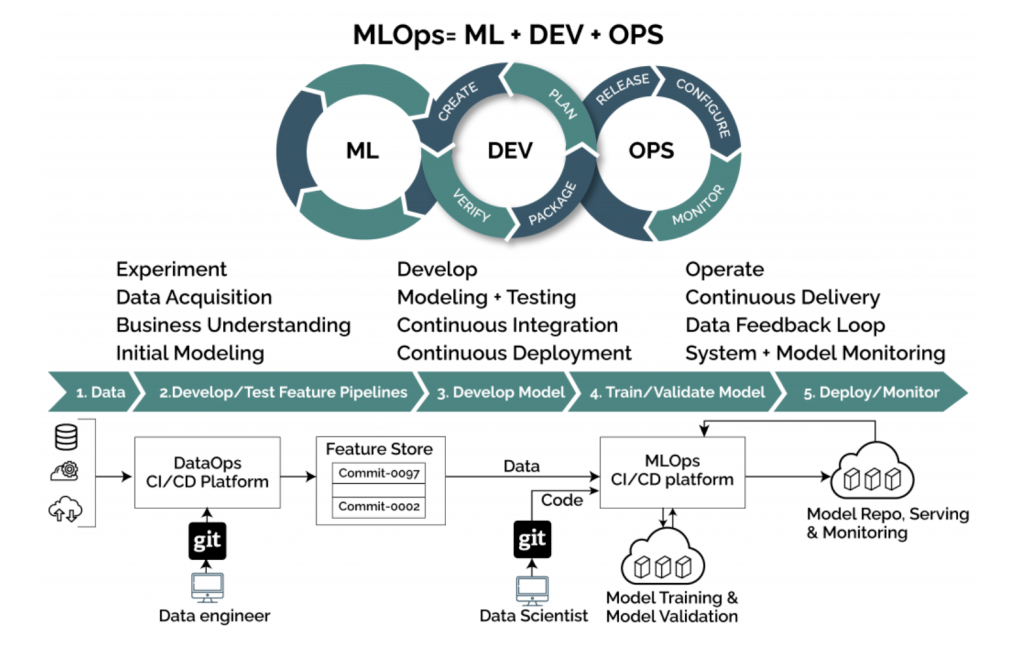
The MLOps workflow typically consists of the following steps:

  1. Data preparation: In this step, data scientists prepare and preprocess the data that will be used to train the machine learning model.
  2. Model development: In this step, data scientists use machine learning algorithms to train the model on the prepared data. They also evaluate and optimize the model’s performance using techniques such as hyperparameter tuning and cross-validation.
  3. Model deployment: In this step, the trained machine learning model is deployed to a production environment using MLOps practices and technologies such as CI/CD, IaC, and containerization.
  4. Model monitoring and maintenance: In this step, the deployed model is continuously monitored and maintained using MLOps practices and technologies such as model monitoring, automated testing, and container orchestration.

MLOps is a rapidly growing field that has become essential for businesses that want to derive value from their machine learning investments. By leveraging MLOps practices and technologies, organizations can streamline the machine learning lifecycle, reduce deployment times, improve performance, and enhance security and compliance. While MLOps is still a relatively new field, it has the potential to transform the way that organizations build and deploy machine learning models, and to drive innovation and growth across industries.

Link – https://medium.com/@Abhishek_Srivastava/mlops-bridging-the-gap-between-machine-learning-and-operations-abb47b5c03aa

Featured

Innovate and Automate

Digital transformation is pushing companies out of their comfort zones and causing them to change and adapt to the ever-growing digital world. According to a recent Gartner report, “driven by cloud, digitalization, and the pandemic, enterprises are adopting new networking technologies faster than previous years.” Another Gartner report showed 58% of organizations surveyed increased their technology investment in 2021, double what it was in 2020.

Join Abhishek Srivastava and a select group of industry executives on 1st June 2022 | 11:30am EST as we discuss the challenges with digital and cloud transformation journeys, as well as how to utilize the right technologies to ensure resilience, scalability, and security. #AIatWork, #AbhishekSrivastava, #AILeader, #MeettheBoss

Featured

Recognition of abhisrivastava.com on 20 Best Enterprise Architecture Blogs and websites

It feels great to appear in The best blogs about Enterprise Architecture from thousands of blogs on the web ranked by traffic, social media followers, domain authority & freshness by Feedspot. Here is the list published by Feedspot.com. They curated more than 250,000 popular blogs and categorized them in more than 5,000 niche categories and industries. Feedspot’s research team spend time and effort over millions of blogs on the web, finding influential, authority and trustworthy bloggers in a niche industry .  More details can be found here –https://blog.feedspot.com/enterprise_architecture_blogs/

#BestEnterpriseArchitectureBlogs; #TopITBlogs; #BestTechnologyBlogs; #AbhishekSrivastava; #TopTechnologyLeaders

Featured

The new world of composable Enterprises?

A composable enterprise, defined by Gartner as “an organization that delivers business outcomes and adapts to the pace of business change”, relies on the assembly of interchangeable application building blocks. This architectural overhaul has largely been driven by a demand for more configurable application experiences, and the need to evolve existing application portfolios that are often too risky and costly to replace.

New business opportunities require agility from application portfolios; however, many enterprises are still limited in their ability to adapt. Why? They rely on monolithic ERP systems and cumbersome legacy applications with static processes and haphazard structures. A modular setup can enable a business to rearrange as required depending on external or internal factors, such as shifts in consumer attitudes or sudden supply chain disruptions. Organizations are experiencing these shifts now and require a new approach to enterprise applications to be able to adapt. 

Bridge the CX Gap with Greater Composability

A composability approach is the best way to capture all the advantages of modern enterprise software. According to a recent Boomi report, by 2023 organizations that have adopted a composable approach will outpace the competition by 80% in the speed of new feature implementation. This shift requires enterprises to rethink how they architect their operations, harness a combination of packaged functions and technologies and successfully deliver seamless moments of service to their customers.

There are three key ways that businesses can make the composability shift:

  • Adopting a service mindset
  • Scaling the delivery of microservices
  • Packaging business capabilities using Application Programming Interfaces (APIs). 

1. Designing for Service: Compete on Outcomes, not on Products 

A composable enterprise whose portfolio is made up of heterogeneous applications from a palette of best-of-breed solutions allows organizations to address key inflection points throughout every customer, product or service lifecycle.

As more consumers demand continuous value and reliability throughout an asset’s lifetime, businesses must shift to selling outcomes and experiences instead of products to meet these new expectations for quality service. This requires each part of an operation to align, not around immediate sales or revenue, but around delivering a quality Moment of Service™ — the inflection point where everything comes together to create better value and outcomes for customers. 

Moving to a servitized model requires a composable stack to deliver services to order. At a systems level, this transformation requires organizations to adapt applications dynamically and deliver positive customer experiences with effective quality management, customer support, and access to complete information about the service offering. Unlike traditional enterprise software, this involves connecting data and applications that have often sat in separate silos. A composable enterprise can provide a service-orientated architecture, that enables businesses to become outcome-based and ready to quickly adapt to future disruptions. 

2. Scale Component-based Architecture with Microservices

If applications are built as loosely coupled services, then companies can employ a composable architecture to capitalize on independently deployable modules that are organized around business capabilities. This allows organizations to swap modules in and out, to suit emergent needs and build a well-structured best-fit solution for their unique business. 

In contrast to a monolithic architecture, businesses can easily add resources to the most needed microservice rather than having to scale the entire application as demand for an application increases. In practice, this allows businesses to simplify customizable workflows and optimize business processes while leveraging and applying tools such as robotic process automation, artificial intelligence, or the plethora of hyper-automation capabilities available today.

3. Embrace Open-ended APIs to Maximize Data-sharing Capabilities

Packaged business capabilities (PBC) assembled using APIs are the foundation of every composable enterprise. They are used by businesses to secure data across cloud services, business systems and mobile applications. Historically, APIs have been used in monolithic applications to exchange data between the entire application and external applications and services. In composable software, APIs exchange data from individual modules to external applications and within the application — from module to module. This has significant implications for how systems are designed and built.

APIs can provide a controlled and consumable method for connecting and sharing consumer and business data by creating experiences tailored to individual needs. For instance, an API-centric model can secure and manage data access to help businesses with faster decision-making and deliver relevant new services adaptable to market changes. In the future, there will be more automated continuous process improvements as machine learning models recommend, or even proactively make, process changes to improve outcomes for the business and end customer.

Opt-in to the Composability Evolution

To overcome the limitations of monolithic applications, businesses must rethink their approach to enterprise applications — starting with the business architecture and technology stack. A composable software architecture enables organizations to address the internal and external pressures that send shockwaves throughout the value chain. 

As a composable enterprise, organizations can re-engineer their businesses to ensure customer touchpoints and stages come together for better moments of service, but companies must be certain that processes are optimized across each of these inflection points to mitigate issues and fuel growth. An IT architecture built on a foundation of composability will be essential to the successful delivery of a software-powered business development strategy that can provide continual value to customers and the business itself.

Credit – Rick Veague at CTO Universe